
 by
by In today’s fast-paced digital environment, marketers and senior VPs face increasing pressure to stand out. Static content is having a hard time keeping attention; modern buyers want dynamic media. That’s where Interactive content steps in. Interactive content helps marketers guide customers through their buying processes, changing how businesses attract new clients.
Interactive content isn’t a trend, it’s a proven way to educate, engage and convert prospects. Demand Gen Report reported that 62% of B2B buyers prefer practical, actionable content like case studies, aiming for relevance and interaction. In this guide we break down the actionable steps for effectively using interactive content within your marketing strategy.
1. Understanding the Buyer’s Journey
All marketers understand that customers do not suddenly feel motivated to buy products. Buyers follow a clear path when making purchases and you need to understand their journey. Understanding how customers move through their decision path helps to create content that connects with them. This process, known as the buyer’s journey.
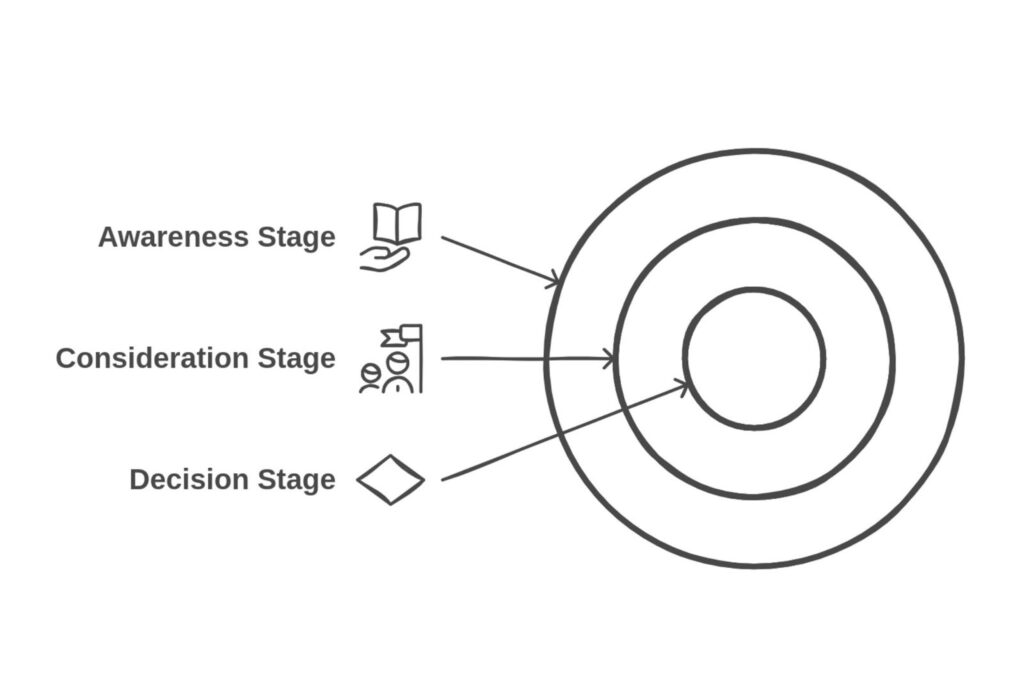
- Awareness Stage: What’s the Problem?
At this point, your buyer understands there’s something off, but they can’t point out exactly what it is. What they want is information, trying to work out what is going on.
For instance, meet Sarah. She’s a marketing manager who has realized her site isn’t converting visitors well enough. It could be slow page speed, poorly designed landing pages, or unclear messaging. Sarah starts Googling things like:
- What is the best way to increase website conversions?
- Why isn’t my landing page converting?
Interactive content is where it shines. Suppose Sarah finds a quiz about ‘Is Your Website Conversion Optimized. She is asked simple questions around her site’s load times, call to action placement, etc. and gets a personalized result. By the end Sarah finds her landing pages need better calls to action and gets actionable tips on how to improve them.
- Consideration Stage: Exploring Solutions
Sarah has now figured out her problem, and has begun assessing solutions. Should she hire a consultant? Redesign her website? Should you invest in a website personalization tool? She’s comparing and weighing the pros and cons at this stage.
For instance, imagine you have a Saas personalization website and Sarah lands on your website and she sees an ROI calculator. Within the tool, she can input her website’s current conversion rate, and see how much she could improve it. She also watches an interactive video where the video walks her through the platform and shows her how it can solve her problem.
In this stage, it’s about delivering value-driven, actionable content that makes Sarah feel informed and confident in her choices.
- Decision Stage: Choosing a Solution
At this point Sarah has narrowed her options down to a few tools. She’s ready to decide, but she wants to know that she’s making the right one.
That’s where interactive case studies and demos step in. Sarah visits your website, sees your case study for a SaaS company in her industry that has raised conversions by 30% using your tool, and clicks on it. The case study isn’t merely a PDF, but an interactive one with clickable charts and a walkthrough of what the solution looked like.
Finally, she schedules a tailored demo that walks her team through your integration with her existing CRM, and shows how your platform meets their particular needs. She can now picture how your solution will play out for her, and is comfortable going forward.
The buyer’s journey isn’t only about getting customers to the finish line; it’s about meeting customers where they are. Whether it’s quizzes that educate, calculators that quantify value or demos that build trust, interactive content transforms every stage into a great experience.
Read: Top Marketing Tools that You Can Leverage for Your Business Growth
2. Benefits of Interactive Content
Now that we’ve covered the buyer’s journey, it’s time to discuss why interactive content is a game-changer. Interactive content isn’t a buzzword; it’s a proven way to change the way buyers interact with your brand. It delivers value at every step of the buyer’s journey from boosting engagement to building trust.
- Driving Engagement and Action
Engaged users will trust your brand, remember your message, and take action whether it’s demo sign up or sharing their contact details for more insights.
Now let’s go back to Sarah’s journey. She didn’t just skim through the quiz about website optimization, she was actually involved. That’s the beauty of interactive content: it makes your audience actively participate, from passive readers to participants. This is not anecdotal, industry data shows that interactive content produces 2x more leads than static formats, because it’s more memorable and impactful. Sarah found that the interactive quiz not only kept her attention but also helped her identify what was weak on her website. She felt a part of the process, rather than being overwhelmed with information, so it felt tailored and helpful.
- Personalization: Speaking Directly to the Buyer’s Needs
Personalized content makes buyers feel seen. It establishes your brand as a real understanding of their challenges and the right solutions to them.
Personalization was another reason Sarah stayed with your brand. Quiz results on the ROI calculator were all experiences that felt like they were built with her in mind truly. It wasn’t just generic advice; it was actionable, relevant and clear. This is a game-changer in modern marketing. The Demand Gen Report reports that 62% of B2B buyers value practical, data-driven content like case studies in making informed decisions. When you deliver personalized experiences, you tell buyers that you know their specific challenges and can provide value.
For instance, the ROI calculator used by Sarah didn’t just show abstract numbers. It was a specific value, a clear, trust-building moment, that helped her understand the value she could get from fixing her site’s conversion issues and helped her further down the funnel.
- Lead Generation: Turning Interest into Action
Interactive content isn’t just about bringing in buyers, it’s also about driving results. When Sarah put in her email to look at her quiz results or saved her calculator estimate, she wasn’t just engaging; she was becoming a lead. Not just a lead, but a lead that’s warmed up and more likely to convert. Interactive content works by naturally bridging the gap between curiosity and commitment by giving value first. Not only does it lead to better engagement but it also creates a pipeline of qualified leads that trust your expertise.
It could be the quiz that draws the eyes, the calculator that makes insight personal, or the demo that closes the sale, but all interactive content is changing how buyers interact with your brand. No surprise that 93% of marketers agree that interactive content actually converts and educates better than static formats.
Pro Tip: First, begin with one type of interactive content such as a quiz or calculator aligned to a particular stage of your buyer’s journey. See how it drives both engagement and leads.
3. Types of Interactive Content
With the why behind interactive content in place, it’s time to talk about the what. But what types of interactive content can you use to truly engage your audience, and guide them through their journey? Many tools and formats exist to construct memorable experiences. Now, let’s look at some of the most effective ones.
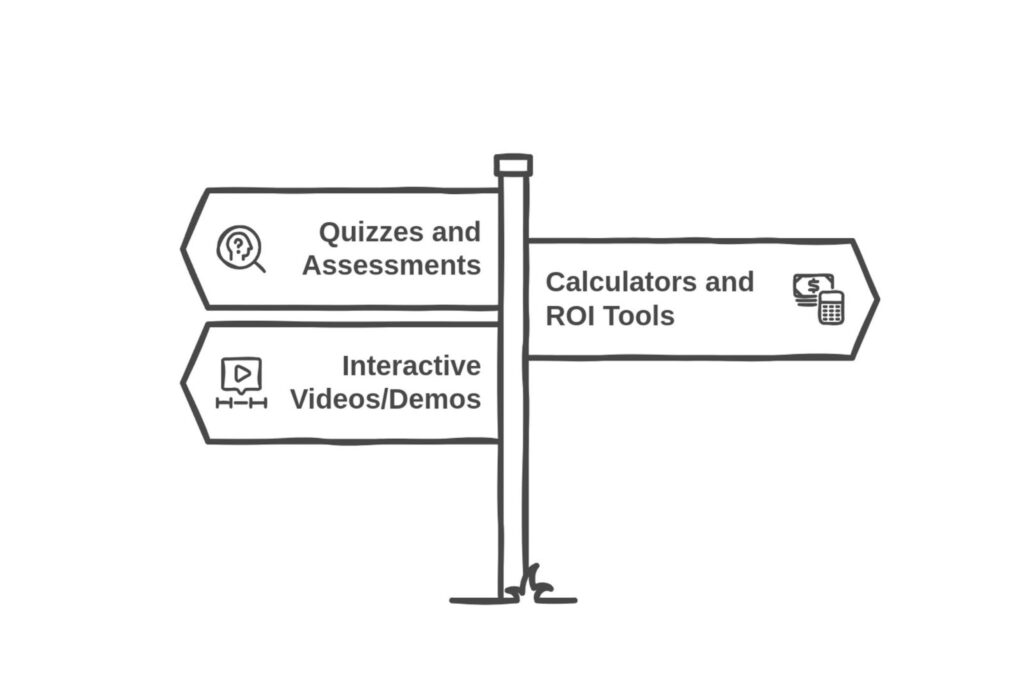
- Quizzes and Assessments
If you’ve been on social media or a website, you’ve probably seen quizzes that pop up like “What’s your personality type?” or “How optimized is your website for conversions?” Interactive content such as these quizzes is a great example of something that will engage the user but also provide valuable insight. The Quiz that Sarah took about optimizing her website wasn’t just fun; it helped her figure out exactly where she needed to be better. And here’s the kicker: Quizzes are a great way to get information from your leads.
- Calculators and ROI Tools
The calculator is another powerful tool and if it’s built to help your users see the impact of your solution, even more powerful. It’s like Sarah’s ROI calculator, where you can calculate how your product will raise her conversions. Sarah was able to instantly see the potential return on investment by entering her data, which made the decision to move forward almost feel effortless. Calculators are not only for SaaS companies, they are useful across industries, to help calculate everything from costs to savings, time saved, or revenue generated. The best part? It’s incredibly personalized. The results that users get each time they input data are directly related to their unique situation.
- Interactive Videos/ Demos
If you really want to keep your audience engaged, interactive videos are a great option now. The combination of video storytelling and interactive elements allows users to choose their path, click on hotspots to get more info, or even answer questions. Imagine an interactive demo video where Sarah can click through different features on your platform, and where she can spend time looking through the features that were the most relevant to her needs. Instead of just watching a passive demonstration, she attempted to become an active learner of your product.
Take Storylane, for example. Using an interactive demo, they successfully showed their product on their website. Not only did they increase engagement by allowing users to interact directly with the product, but they also increased their website visibility.
These formats are beautiful because they’re more than just a source of information; they’re an experience. Interactive content is an excellent way to engage your audience as they actively interact with your brand, learn more about what you have to offer and how it relates to their own needs. Whether it’s a quiz, a calculator or an interactive video, each format provides something of value to move buyers through the journey.
4. Implementing Interactive Content Strategies
Now that we’ve looked at the different types of interactive content, let’s change gears and discuss how we can actually implement them. While understanding the benefit of interactive content is one thing, understanding how to develop a strategy, and then execute on it is where the real magic comes in.
- Content Creation Tips
The first thing you need to think about when it comes to interactive content is that it has to resonate with your audience. What you want to do is make something that hits the spot for their needs, while holding their attention.
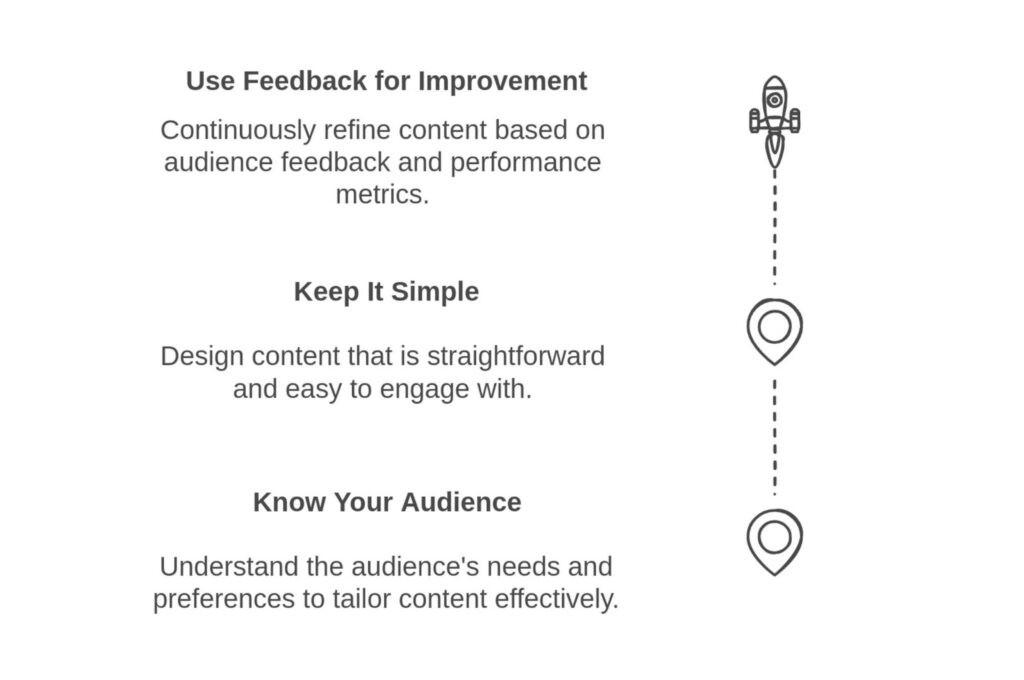
- Know Your Audience: The more you know about your audience, the stronger your content will become. What are their pain points? What keeps them up at night? For a moment, let’s go back to Sarah – if she’s seeking marketing tools that will cut down on her team’s time and improve efficiency, you wouldn’t just plop a random quiz in front of her. Something you’d create, something tailored, like a quick assessment to help her find the tool that’s right for her unique needs.
- Keep It Simple: Simplicity is key. You don’t want to overwhelm your audience with too much. Be short, sweet and to the point. With a 3-question quiz or a 5-minute interactive demo, you can give them a lot of value while not losing their attention.
- Use Feedback for Improvement: After your content goes out, pay attention to how your content is performing. Are people dropping off in the middle of your video? Are they answering your quiz but not clicking through to the results? Don’t be afraid to tweak and improve as you go. Continuous improvement is key to successful interactive content, and the more you test and adjust, the better you’ll become at it.
- Tools and Platforms
Let’s talk tools, and more specifically, tools that will make magic out of all of this interactive content. Have you ever wondered how you can personalize your content for every single visitor on your site, without a big technical headache? That’s where a conversion rate optimization platform comes in.
Personalized experiences not only make your audience feel seen but also boost your conversion rates, too. Imagine this: If you have quizzes, surveys or assessments on your website a user is surfing your website and while they interact with quizzes, surveys or assessments the content on your website shifts and changes depending on the user’s actions. Pretty cool, right? By offering specific content to each visitor, rather than generic content, you are more likely to get the visitor to take the next step, whether it’s downloading an ebook, signing up for a demo, or even buying something.
Conclusion:
Interactive content has over and over again demonstrated itself to be a powerful game-changer in how buyers interact with brands over the course of their journey. Quizzes in the awareness stage, personalized demos in the decision stage, and interactive content create value at every touchpoint along the path to purchase. It helps marketers drive deeper engagement, deliver the tailored experiences that a customer desires, and generate qualified leads. As a marketer, now is the perfect time to try out interactive formats as part of your content marketing strategy, including quizzes, ROI calculators and interactive videos. By using these strategies you can increase engagement and also your overall marketing results.
Author’s Bio:
Vidhatanand is the Founder and CEO of Fragmatic, a web personalization platform for B2B businesses. He specializes in advancing AI-driven personalization and is passionate about creating technologies that help businesses deliver meaningful digital experiences.